My first encounter with Howard the Duck was, appropriately enough, in a pet store.
I was nine years old and wandering through Annette’s Pets. While my dad was looking for new additions to his massive aquarium, I found a crate of comic books selling for less than a dollar each. Of the many rumpled comics jammed together, I was drawn to the second issue of “Howard the Duck.”
A talking wiseacre waterfowl (who was “trapped in a world he never made”) battled the intergalactic Space Turnip.
It was my introduction to a lifelong love for the comic book, my favorite character in the entire Marvel universe.
Some “Ducking” history
‘Howard the Duck’ got his own comic book 50 years ago in 1976. Though he first appeared in a Marvel title called Man-Thing, sorta Marvel’s Swamp Thing, in 1973.
Did you know? Howard first landing on earth is in the Florida Everglades, not Cleveland. pic.twitter.com/zAIfS4rBee
— Better Yet (@LesCarpenter1) August 2, 2026
A few months later, the latest issue of Bantha Tracks, the Lucasfilm Fan Club newsletter, arrived in the mail. The front page announced that George Lucas was producing a film adaptation of “Howard the Duck,” his first major film project since “Return of the Jedi” (1983).
Subsequent issues provided further behind-the-scenes info and, month by month, whetted my appetite for what looked like the biggest movie of the year.
No joke, even in the summer of 1986, which included “The Karate Kid Part II,” “Aliens” and “Top Gun,” the growing hype over “Howard the Duck” was hard to miss. With imagery of the title character kept top secret until opening day, Lucas’ name all over the promotional materials (though he was the executive producer and not the director) and a then-massive, $40 million budget, Howard looked to make as big a splash as “Superman – The Movie” (1978).
Then it opened.
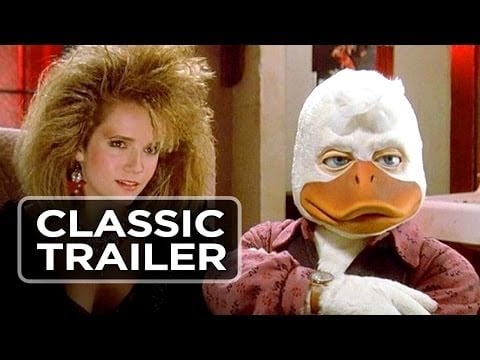
This is the movie where a dreamy Lea Thompson plays Beverly Switzler, the big-haired lead singer of “Cherry Bomb” (no doubt a reference to The Runaways). Switzler falls in love with Howard, a talking duck who has been blasted from his duck planet down to Earth.
Beverly meets Howard in a Cleveland alley, where he saves her from being raped by thugs. Thankfully, Howard is “a Master of Quack Fu” and dispatches her attackers.
The two then live together and form a flirtatious romance (in the comic book, it goes all the way, but I digress). Beverly’s kind-of pal, Phil (Tim Robbins), is a scientist who wants to exploit Howard more than return him to his home planet.
There’s also Dr. Jennings (Jeffrey Jones, who played Principal Rooney the same summer in “Ferris Bueller’s Day Off”).
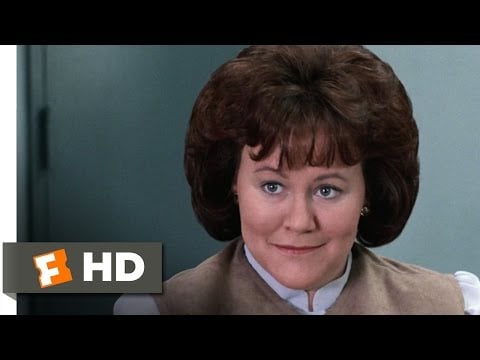
Things feel off from the first frame. The cleverly constructed indoor and exterior views of the planet “Duck World” are set to John Barry’s lush, romantic score, which is, note for note, utterly wrong for this movie.
Barry was coming off of “Out of Africa” (1985) and was a name composer for this high-profile project, but his jazzy, film noir-lite score sets the wrong tone.
Everything else is off kilter, too: the sense of scale is enormous, but the story wants to be intimate (at first). The comedy alternates between broad and wry, satirical and slapstick-heavy, self-referential and painfully juvenile.
Just when it feels like the movie is settling for an awkward, character-driven sci-fi romantic comedy (!), it switches gears again.
The amusingly droll opening moments, which establish “Duck World” as a satirical, pun-heavy take on planet Earth, are as good as this movie gets.
The subsequent scenes, of Howard suddenly being sucked into the atmosphere, across the cosmos and down to Earth, are truly spectacular. We even have a narrator announce, “In the beginning there was…Howard the Duck,” followed by the title exploding to life.
Unfortunately, as Howard crashes to Earth, so does the rest of the movie.
There are moments, like a montage of Howard walking Cleveland streets alone, that suggest writer/director team (and married couple) Willard Huyck and Gloria Katz understood Steve Gerber’s character. A few throwaway lines are funny and the animatronic duck effects are outstanding. Thomas Dolby’s songs also impress.
“Don’t Turn Away” should have been the breakout single, not the kitschy title song.
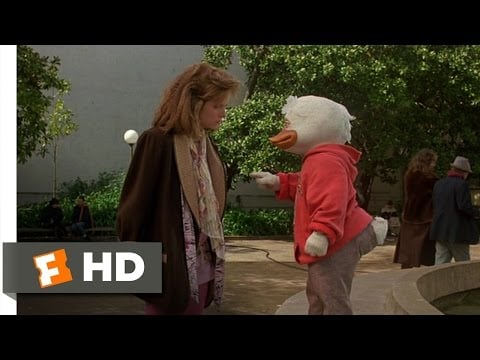
For the first half, everything feels uneven, but you wait for the movie to course correct. It’s at the point that Jones’ Dr. Jennings shows up that the whole thing goes bananas with an endless showcase of busy special effects.
The movie becomes an ordeal.
While never dull, “Howard the Duck” is often unpleasant (a bit with an alien tongue is too much, even for this movie) and insufferable. I don’t blame the cast, who try hard (in Robbins’ case, much too hard), nor Lucas, though his involvement gave movie critics a target to throw their verbal darts.
The biggest problem is that the movie obviously wants to be an f/x-driven, genre-fluid comedy like “Ghostbusters” (1984),. Instead, it’s so untamed (note the out-of-place hot tub sequence and a bit at a nuclear power plant that stops the film), the wry lightness of the earlier scenes are trampled over.
I grew up with this movie and have seen it far too many times. As both a comic book adaptation and a rotten cinematic interpretation of my favorite comic book, I find it fascinating.
Could this work better today, with CGI, or as an animated film, or as a satire of the overload of comic book movies (many of which are even more excessive and stuffed with visual overkill than this was in 1986)?
I certainly hope someone cracks this egg and gives it another go. The noted cameo appearances in the “Guardians of the Galaxy” films (2014-2023) and the Disney+ series “What If…?” (2023) demonstrate that there’s a way to do this the right way.
The film’s cult following and the new interest generated from the recent appearances pinpoint two undeniable facts: the character has a pull in pop culture and the 1986 film, no matter how one feels about it, is technically the first Marvel movie.
It’s certainly the first big-budget comic movie of the decade not to star Christopher Reeve. “Howard the Duck” wound up such a cautionary tale, the subsequent attempts to adapt Marvel material didn’t occur until 1998, with the surprise hit of “Blade” (1998).
New Line Cinema’s risky decision to back the offbeat, wonderful blockbuster “Teenage Mutant Ninja Turtles” (1990) was noted by many as a potential misstep, as the early word of animatronic puppet heads and creature suits reminded some of “Howard the Duck.” While the façade of Howard the Duck proved unconvincing to audiences, the TMNT crew, as well as the violence inflicted by Eric Draven, Stanley Ipkiss and Blade helped jumpstart film studio interest in characters having nothing to do with Batman and Dick Tracy.
The joy of Howard’s plight amongst “hairless apes” and griping against a broken world still has resonance in comic book form. As is, the “Howard the Duck” movie burdens itself with being a “comic book movie” in a broad sense.
Yes, Howard is a cosmic figure, but the movie forgets it’s about a duck who just needs to find a job to support his “hairless ape” girlfriend. The character is too good not to work as a movie.
For now, the 1986 adaptation is such a loud, overlong botch, it’s the audience, not Howard, who will feel like they’re trapped in a world they never made.
The post ‘Howard the Duck’ at 40: Time Has Not Been Kind appeared first on Hollywood in Toto.
from Movies - Hollywood in Toto https://ift.tt/Ix8peMu










0 Comments