Writer/director Michael Crichton’s “Looker” (1981) is awash in 1980s kitsch but is still one of the most intriguing of his sci-fi cautionary tales.
Despite taking place in a sea of neon, eyeliner, bad haircuts and synth pop, Crichton is warning us about A.I. just as much Steven Spielberg’s “A.I. Artificial Intelligence” (2001), James Cameron’s “The Terminator” (1984) and Spike Jonze’s “Her” (2013).
The result is a film that falls somewhere in between prophetic and pure guilty pleasure.

Albert Finney stars Dr. Larry Roberts, a Beverly Hills plastic surgeon who discovers that one of his clients died under strange circumstances. Dr. Roberts teams up with his favorite patient, Cindy (Susan Dey), to investigate and discovers that a peculiar and dangerous technology is being created by the “Looker Laboratory.”
As overseen by an oily and ruthless Reston (James Coburn), the breakthrough tech allows artificial intelligence to assume the appearances of willing models and grab the attention of TV watchers through hypnotic ads that viewers can’t turn away from. There’s also the light guns that make victims lose track of time and big, shiny sunglasses that protect us form that very threat.
Or something like that.
Finney is a wonderful actor, but he’s as miscast as he was in the same year’s “Wolfen.” The “Tom Jones” (1963) star gives a functional performance here, visibly working hard and still all wrong for the lead role.
Finney’s being so blatantly out of place and the bad, persistent title song are the biggest missteps, though the whole thing is so goofy, it might have been better as a comedy. Despite the silly execution, the ideas on hand are rich and offer novels twists on tropes like shoot-outs and car chases.
When one considers how easy it is in contemporary times to find dozens of people staring hypnotized at a glowing screen, the once futuristic tech (a combo of A.I. and techno fakery) is persuasive.
The inventive light gun causes victims to lose hours of time through a blast that renders them unaware of how much time they’ve just wasted. Today, it’s called Instagram.
This weapon makes for fun moments. The gun is called the Looker, and it stands for Light Ocular Oriented Kinetic Energetic Responses. I didn’t just make that up.
No, really, I didn’t.
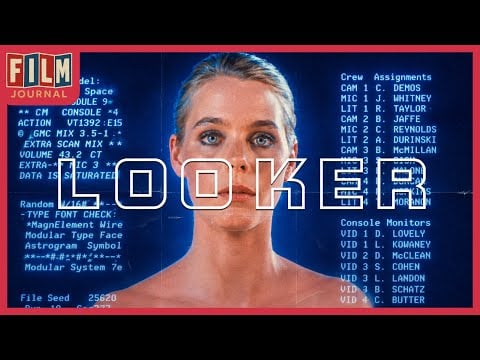
Having someone’s likeness and consciousness absorbed into a computer to shill for commercials is very of the moment (Val Kilmer’s recent A.I. performance, A24 embracing A.I., etc.).
Crichton is exploring the same unsettling questions as in his “Jurassic Park” (1993) and “Westworld” (1973), except instead of resurrected dinos and robot gunslingers, we have digitized supermodels and digital actors. As in Crichton’s “Sphere” (1998), “Looker” has title cards breaking up the story by days of the week, which works fine for a novel but lands with a thud here.
Both silly and compelling, “Looker” is somehow a relic of its time and a cautionary tale for 2026. How seriously anyone takes this depends on the viewer, who can either see this as kind of visionary, truly silly or both.
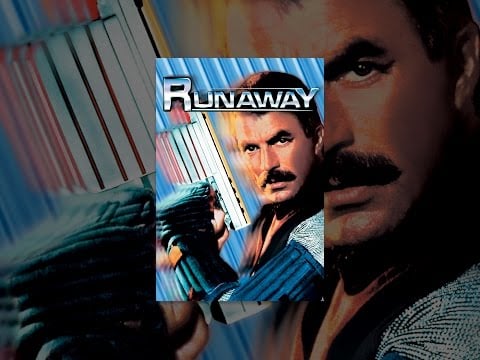
“Looker” left me thinking a lot about its technological concepts and ideas about A.I. replacing us for reasons of commerce. It made me wonder if its time to give Crichton’s silly but exciting, Tom Selleck vs. Gene Simmons “Runaway” (1984) another look.
The post Crichton Saw the Future (Again) with ‘Looker’ appeared first on Hollywood in Toto.
from Movies - Hollywood in Toto https://ift.tt/0mbZg4M









0 Comments