David Lynch’s “INLAND EMPIRE” (2006) begins, fittingly, with a grand gesture.
The spotlight shines on the title, followed by a prelude with a record needle (so the song begins …), blurred black and white footage of a hallway and Polish dialogue.
We see a prostitute and a client with blurred-out faces, then cut away to a character staring at a static TV and crying (not unlike the opening of Lynch’s 1992 puzzle, “Twin Peaks: Fire Walk With Me”). It’s all been shot on digital photography and resembles snippets from our deep unconscious.
You lost yet? Just go with it.

We meet a Hollywood film actress named Nikki Grace (Laura Dern) who has a bizarre encounter with a stranger (an eerie Gracie Zabriskie) who talks her way into Nikki’s home and gives her a vague but menacing warning.
The Dern/ Zabriskie conversation is eerily like the frightening party exchange between Bill Pullman and Robert Blake in “Lost Highway” (1997).
Immediately after this, Nikki is cast in a project with a promising co-star (Justin Theroux) and a confident director (Jeremy Irons) but a dark truth clouds the proceedings. It turns out this new film has a haunted history and is “based on a Polish folktale and said to be cursed.”
The cast and crew carry on until Nikki starts to find it difficult to tell the difference between her real life and the character she’s playing, as moments on and off the set start to blend together. By the midpoint, Irons lays down the lore and, with that, the audience tumbles down the rabbit hole with Dern and Lynch.
RELATED: HOW LYNCH’S ‘MULHOLLAND DR.’ INVADED OUR DREAMS
As with every Lynch film, I find that a second or third viewing goes a long way to fully appreciating (if not fully comprehending) his work. This was also the experience I had with Lynch’s “Wild at Heart” (1990) and “Mulholland Dr.” (2001), two great but challenging, idiosyncratic and casually surrealistic works that seem impenetrable at first.
Your experience may not be the same as mine, but I initially found some of Lynch’s films off-putting and easy to resist. Giving a second or third look has only enriched my affection and understanding but, again, Lynch’s polarizing films (even his most acclaimed) aren’t for everyone.
I saw “INLAND EMPIRE” on opening day, my birthday in fact, at the great Mayan Theater in Denver, Colo. What I remember most about the experience is that for the first two hours (the running time clocks in at a whopping 180-minutes) I sat close to the screen, wanting to absorb everything.
A few massive jump scares and jarring transitions later, I spent the last hour in the row furthest from the screen. I seemed to have forgotten how terrifying Lynch’s films can be, as there are moments in “INLAND EMPIRE” every bit as jolting as the biggest shocks in “Lost Highway” (1997).
We lost Lynch last year, at the age of 78. Now that his body of work has a beginning and end and “INLAND EMPIRE” represents the final theatrical film release of his career (with the awesome “Twin Peaks – The Return” on Showtime his swan song), what can we make of it?
Is it a self-indulgent folly or on the level with his best films? Actually, yes to both of those questions.
If you’ve never liked Lynch’s work, this won’t be the one to change your mind. Also, if you’ve read this far and have never seen a Lynch film, I recommend starting with “The Elephant Man” (1980) or “The Straight Story” (1999).
Lynch’s true masterpiece is probably the entirety of “Twin Peaks” (the first two seasons from 1990-1991, the 1992 prequel film, then the 2017 Showtime mini-series). Nevertheless, while “INLAND EMPIRE” could have used a severe edit before release and has passages it doesn’t need, its best moments, of which there are many, demonstrate how Lynch’s works were thrilling alive, defiant and personal.

Arguably, the most infamous moments here are the bits with a family of rabbits (specifically, actors with large rabbit masks on) who sit around and converse while a laugh track accompanies dialogue devoid of humor. These bits play like an existential goof, not unlike Lynch’s “The Angriest Dog Alive” comic strip (they’re still online and worth a look).
That we see this bizarre segment (with Naomi Watts and Scott Coffey among the voices of the Rabbit family) before the story kicks in is a bold touch.
Repeat viewings of “INLAND EMPIRE” are essential, as it’s initially difficult to gauge which narrative we’re supposed to invest in (my take- everything is a subconscious prelude until Dern shows up).
For Lynch completists and adventurous filmgoers, there’s much here to savor, let alone wrap your head around. Fans of “Wild At Heart” will note that the film’s Oscar-nominated MVP, Diane Ladd, has a nutty cameo appearance here as a talk show host (meanwhile, William H. Macy has exactly one line in one very brief scene).
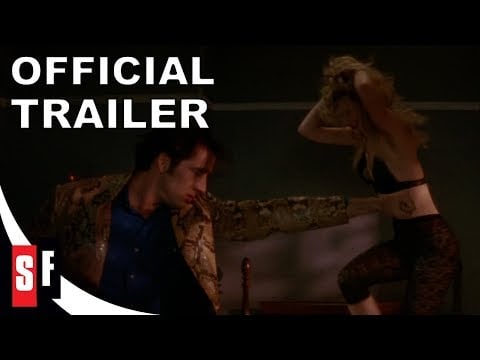
The title of Nikki Grace’s vehicle, “On High Noon in Blue Tomorrows,” even sounds like it could be an extension of the “Invitation to Love” soap opera that captivated the town of Twin Peaks.
“INLAND EMPIRE,” in the best way, often feels like an extension of the themes within “Mulholland Dr.” Both works contrast the real and unreal, Hollywood gloss and ugly reality and show us something so beautiful, followed by a truly ghastly vision.
These are consistent themes with Lynch’s work.
Of the moments I savor, Julia Ormond has one scary single scene as a suspect being interrogated by a cop. Terry Crews shows up as a homeless man. Oh, and there’s a musical number! Two, in fact. Okay, now I sound like I’m describing a dream.
I’ll conclude with a quote from Lynch’s 2006 book, “Catching the Big Fish,” about how his ideas manifest themselves. The chapter entitled “INLAND EMPIRE” begins this way:
“When we began, there wasn’t any INLAND EMPIRE, there wasn’t anything. I just bumped into Laura Dern in the street, discovering that she was my new neighbor. I hadn’t seen her for a long time, and she said, ‘David, we’ve got to do something together again.’ And I said, ‘We sure do. Maybe I’ll write something for you. And maybe we’ll do it as an experiment for the Internet.’ And she said, ‘Fine.’”
The brief chapter has Lynch recalling how a lengthy monologue became something even bigger. Lynch concludes the chapter with this:
“But it wasn’t until halfway through that, suddenly, I saw a kind of form that would unite the rest, everything that had come before. And that was a big day. That was a good day, because I could pretty much say that it would be a feature film.”
The post Why ‘INLAND EMPIRE’ Was Pure, Unfiltered Lynch appeared first on Hollywood in Toto.
from Movies - Hollywood in Toto https://ift.tt/76ARLqD









0 Comments